
Introduction: Why 2024 Was a Defining Year for Quantum Computing
The latest breakthroughs in quantum computing 2024 did not arrive with a single dramatic announcement. Instead, they came through a series of measured, meaningful advances across hardware, software, algorithms, and real-world deployment. For researchers, investors, and businesses paying close attention, 2024 confirmed something important: quantum computing is moving from the research lab into the early stages of practical use.
This article gives you a complete and honest picture of what actually changed in 2024, why those changes matter, what problems still remain, and where the technology is heading next. Whether you are a professional in the field or simply trying to understand what quantum computing means for the future, this guide is designed to give you everything you need.
What Is Quantum Computing? A Clear Starting Point
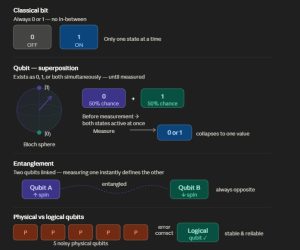
Quantum computing is a fundamentally different approach to processing information. Classical computers use bits that are either 0 or 1. Quantum computers use qubits, which can exist as 0, 1, or a combination of both at the same time — a property known as superposition.
When multiple qubits become linked through a quantum phenomenon called entanglement, the system can represent and process a vast number of possibilities simultaneously. This gives quantum computers a theoretical advantage over classical machines on specific categories of problems.
Three key concepts define where the field stands today:
- Physical qubits are the actual hardware components on a quantum chip.
- Logical qubits are more stable, error-corrected units built from multiple physical qubits.
- Fault-tolerant quantum computers are future systems that will use logical qubits reliably enough to run complex, real-world programs.
Most machines today operate in what researchers call the Noisy Intermediate-Scale Quantum (NISQ) era. These devices have tens to a few hundred qubits and are useful for specific experiments, but they cannot yet run the large, general-purpose algorithms that will unlock quantum computing’s full potential.
Error Correction Takes a Major Step Forward
Google’s Willow Chip: A Landmark in Quantum Error Correction
One of the most talked-about latest breakthroughs in quantum computing 2024 was Google’s introduction of the Willow processor in December. This 105-qubit chip demonstrated something researchers had been working toward for years: below-threshold quantum error correction.
The team organized qubits into grid patterns of 3×3, 5×5, and 7×7 configurations, testing different code distances. The remarkable result was that as the grid size increased, error rates went down rather than up. This is the opposite of what happens in classical systems, where adding more components typically introduces more risk.
What this means in practice:
- Scaling quantum processors can actually reduce errors at the logical qubit level.
- Encoded logical qubits can hold information longer than single physical qubits.
- The path toward genuinely fault-tolerant machines is technically feasible.
Willow also ran a benchmark test called random circuit sampling, completing a task that would take classical supercomputers an unimaginably long time. While this does not translate directly to a business application, it is a strong proof of concept that quantum hardware can outperform classical systems on carefully chosen tasks.
Quantum and the Topological Qubit: A Different Kind of Stability
Another significant result came from Quantum , working alongside researchers from Harvard and Caltech. The team achieved one of the first credible experimental demonstrations of a topological qubit using a trapped-ion system known as H2.
The logic behind topological qubits is different from conventional approaches. Instead of storing information at a specific point in the system, a topological qubit encodes information in the global pattern of the whole system. This makes it naturally more resistant to local disturbances the quantum equivalent of a document that stays readable even if individual letters become blurry.
The experiment was small in scale, but it provided real evidence that topological designs could eventually produce logical qubits using fewer physical resources than current surface-code methods. That would make large-scale quantum hardware significantly cheaper and easier to build.
Algorithms and Real-World Applications Begin to Converge
Chemistry and Drug Discovery
One of the clearest areas of early practical value is chemistry and materials science. Microsoft’s Azure Quantum Elements platform combined artificial intelligence, high-performance classical computing, and quantum techniques to model complex reaction networks. In one project alone, scientists ran over a million advanced chemistry calculations and used quantum-assisted tools to reach energy estimates that would be extremely difficult to achieve through purely classical means.
Separately, a team led by Pasqal used neutral-atom quantum processors to study how water molecules behave inside the binding pockets of proteins. Understanding this interaction is critical for drug development, as it directly affects how pharmaceutical molecules bind to their biological targets. This is precisely the kind of simulation that stretches classical computers to their limits.
Artificial Intelligence and Machine Learning
The quantum-AI intersection produced some of the most creative work in 2024. Rather than trying to replace classical machine learning models, researchers focused on how quantum circuits can complement them.
Quantum developed LAMBEQ, a quantum-based natural language processing toolkit, that uses circuits to capture sentence structure in a way that remains mathematically transparent and trainable. Terra Quantum built a hybrid quantum neural network capable of classifying liver images using just a handful of qubits, all within a federated learning setup that kept patient data inside individual hospitals.
These are early-stage experiments, but they establish an important precedent: small quantum models can work alongside existing AI infrastructure, particularly in sensitive environments where privacy and interpretability are priorities.
Physics, Engineering, and Scientific Simulation
Quantum computers also proved their value as scientific instruments in 2024. Teams at Riverlane and MIT used quantum hardware to model plasma behavior relevant to fusion energy research. BQP conducted quantum-assisted simulations of simplified jet engine fluid dynamics. Other groups used quantum devices to test behaviors in quantum field theory that cannot be studied any other way.
These applications are still limited in scale, but they point toward a future in which quantum processors act as specialized components inside much larger scientific simulation workflows.
Industry Infrastructure and Investment Grow Significantly
Better Hardware, Wider Cloud Access
The latest breakthroughs in quantum computing 2024 were not confined to laboratory demonstrations. Quantum’s H2-1 trapped-ion system reached 56 fully connected qubits with very high gate fidelity. IBM, Google, Microsoft, Amazon, and IonQ all expanded their cloud-based quantum computing services, making it easier for research teams and businesses to access different types of hardware without owning and maintaining their own systems.
The industry narrative in 2024 shifted noticeably. The focus moved away from simple qubit count announcements and toward quality, stability, and error correction. This is a healthy sign that the field is maturing and beginning to think about what it will take to support real workloads.
Funding, Market Growth, and Long-Term Commitment
On the financial side, quantum computing continued to attract serious capital in 2024. Hardware, software, and component startups collectively raised several billion dollars. National governments across multiple regions launched or expanded quantum programs worth tens of billions of dollars over the coming decade.
Direct commercial revenue from quantum computing remains modest today, but the long-term outlook is shaped by a clear understanding of what it takes to build this technology:
- Years of sustained engineering to move from one-off demonstrations to reliable commercial products.
- Multidisciplinary teams spanning quantum physics, electrical engineering, software development, and materials science.
- Significant physical infrastructure including cryogenic cooling systems, precision control electronics, and specialized fabrication facilities.
The scale of investment signals that major stakeholders see today’s progress as genuine and are willing to fund the long road to commercial maturity.
The Honest Picture: Quantum Computing Challenges That Still Remain
Any complete account of the latest breakthroughs in quantum computing 2024 must also address what is not yet solved. Several deep challenges continue to define the boundaries of what is currently possible.
1. Scaling to Meaningful System Sizes
The most powerful quantum algorithms are expected to require thousands of logical qubits, which in turn means potentially millions of physical qubits. Current leading chips like Willow and H2 are genuine advances, but they remain far from that scale. Closing this gap is one of the most difficult engineering problems in modern technology.
2. Noise, Fragility, and Engineering Complexity
Qubits are extraordinarily sensitive. Superconducting qubits must operate near absolute zero and lose their quantum state within microseconds. Even tiny environmental disturbances — vibrations, heat, electromagnetic interference, or manufacturing defects — can corrupt a calculation.
Managing this at scale requires sophisticated cryogenic systems, precisely timed laser or microwave control signals, and careful hardware layouts designed to minimize interference between neighboring qubits. Calibrating and stabilizing many interacting qubits simultaneously is a technical challenge that grows rapidly with system size.
3. Algorithm Limitations and Verification Problems
On the software side, the number of problem types that genuinely benefit from quantum speedups remains limited. Factoring large numbers, certain optimization searches, and some physics simulations are clear cases. Many proposed applications in machine learning and optimization are still experimental, and researchers have not yet proven they will outperform the best classical algorithms at scale.
Verifying the output of a large quantum computation is also difficult when the system is too large to simulate classically. This raises important questions about how results can be trusted and validated.
4. Encryption and Post-Quantum Security
A fault-tolerant quantum computer capable of running Shor’s algorithm at scale could theoretically break widely used public-key encryption systems such as RSA and elliptic-curve cryptography. No such machine exists today, but the threat is real enough that many organizations are already adopting post-quantum cryptography (PQC) standards. Data encrypted today could be harvested and decrypted in the future, making early preparation essential.
5. Workforce Scarcity and Economic Access
Quantum computing requires a rare combination of expertise across quantum physics, computer science, electrical engineering, and applied mathematics. Building and maintaining systems is expensive, and most organizations access quantum hardware through shared cloud platforms rather than owning it directly. This limits the depth of optimization and control available to most users and keeps the field in a pilot project phase rather than large-scale deployment.
Emerging Real-World Use Cases: Where Early Value Is Appearing
Drug Discovery and Precision Medicine
Quantum tools are beginning to support researchers working on molecular simulation, protein binding analysis, and even clinical decision-making tasks such as transplant matching. The goal is to accelerate the journey from laboratory discovery to clinical treatment by making key computational steps faster and more accurate.
Materials Science, Energy, and Climate
Quantum simulations are being used to study battery chemistry, improve catalysts for industrial processes, model plasma for fusion energy, and develop advanced fluid dynamics models. More accurate simulations could lead to cleaner energy production, better-performing materials, and more effective climate modeling tools.
Finance, Logistics, and Optimization
Financial institutions and logistics companies are running early experiments in portfolio optimization, risk analysis, and routing problems. Most of these projects still rely on simulators or modest hardware, but they are laying the groundwork for future deployment once systems become more capable.
AI Infrastructure and Data Analytics
Researchers are developing quantum subroutines for matrix operations, eigenvalue estimation, and dimensionality reduction. In the future, these could function as specialized accelerators inside larger AI pipelines, handling specific computationally intensive tasks while classical systems manage the rest.
What to Expect Beyond the Latest Breakthroughs in Quantum Computing 2024
The latest breakthroughs in quantum computing 2024 collectively tell a story of steady, credible progress. The field is not experiencing a sudden revolution, but it is advancing in ways that matter. According to McKinsey’s analysis, 2025 marked the turning point where quantum began moving from concept to reality a trajectory that 2024’s breakthroughs directly enabled.
Over the next two to three years, it is reasonable to expect:
- More logical qubits with lower error rates, moving steadily toward fault-tolerant operation.
- Broader adoption of hybrid quantum-classical workflows in sectors such as pharmaceuticals, chemicals, and financial services.
- Continued rollout of post-quantum cryptography standards across governments and enterprises.
- Early quantum communication networks in limited geographic regions.
Looking further ahead into the late 2020s and 2030s:
- The first genuinely fault-tolerant machines capable of running extended programs on dozens or hundreds of logical qubits.
- Demonstrated quantum advantage on real industrial problems rather than artificial benchmarks.
- Deeper integration of quantum processors into cloud computing and AI infrastructure as specialized accelerators.
The story of 2024 is not about a technology that arrived fully formed. It is about a technology that is maturing in the right ways through better error correction, higher-quality hardware, smarter algorithms, and a growing ecosystem of researchers, companies, and governments committed to the long-term work of making it real.
Conclusion
The latest breakthroughs in quantum computing 2024 represent something genuinely meaningful: a year in which the technology grew more reliable, more practical, and more connected to real-world problems. From Google’s landmark error correction result and Quantum’s topological qubit demonstration to expanding cloud access and billions in new investment, the field moved forward on multiple fronts simultaneously.
Major challenges in noise control, system scaling, algorithm development, and workforce training remain. But the direction is clear, and the commitment from both the private sector and governments around the world is serious. Quantum computing will not transform industries overnight, but the foundations being built today make that transformation increasingly likely in the decade ahead.
Staying informed about these developments is not just useful for researchers and technologists it matters for anyone whose work, security, or industry may one day be shaped by what quantum machines can do.
Frequently Asked Questions About Quantum Computing in 2024
Is quantum computing actually useful right now?
Yes, in limited ways. Quantum devices are being used for chemistry simulations, certain machine learning experiments, and materials research through cloud access. However, they are not yet ready for broad commercial workloads and are primarily in the research and pilot project phase.
What was the single biggest change in 2024?
The most significant shift was from simply adding more qubits to demonstrating genuine improvements in error correction, qubit quality, and practical application. Google’s Willow chip showing below-threshold error correction was the standout hardware result of the year.
Is your encrypted data at risk from quantum computers today?
No, not today. Current quantum machines are far too small and noisy to threaten modern encryption. However, the long-term risk is real, which is why post-quantum cryptography is being developed and deployed now, before powerful machines exist.
What are the biggest obstacles holding quantum computing back?
Scaling to large numbers of stable logical qubits, managing noise in complex hardware, proving clear advantages over strong classical algorithms, and addressing the shortage of qualified experts are the central challenges the field must overcome.
Which industries are most likely to benefit first?
Chemistry, pharmaceuticals, and materials science are the most immediately promising areas, followed by certain optimization problems in logistics and finance, and specialized applications in AI and data analytics.
How does quantum computing differ from regular computing?
Classical computers process information as binary bits either 0 or 1. Quantum computers use qubits, which can exist in superposition of both states simultaneously. When combined with entanglement, this allows quantum systems to explore many computational paths at once, offering potential speedups for specific problem types.
Read more Info Visit: https://searchenginegeneral.com/



