

Your AI demo worked flawlessly. The board was impressed. Your development team delivered on time. Yet six months later, the rollout has stalled, employees are frustrated, and leadership is quietly questioning the entire initiative. Sound familiar? Here’s the truth no one in the AI industry wants to say out loud: the problem was never your technology.
What collapsed wasn’t your model’s accuracy or your infrastructure’s capacity. What collapsed was governance or more precisely, the complete absence of it. This article breaks down exactly why AI transformation is fundamentally a governance problem, what 2026’s regulatory landscape demands from your organization, and how to build a framework robust enough to actually survive contact with reality.
Why AI Initiatives Keep Failing And Why Your Technology Budget Isn’t the Answer
Imagine purchasing a Formula 1 racing car, but installing no steering wheel, no brakes, and no safety harness. The engine is magnificent. The aerodynamics are world-class. But without control mechanisms, that vehicle is not an asset it’s a catastrophe waiting to happen.
This is precisely how the majority of enterprises approach AI adoption today. They pour investment into the most capable models, hire elite engineering teams, and build impressive proof-of-concept demonstrations. Then they attempt a company-wide rollout and everything unravels.
The Hard Numbers Behind AI’s Adoption Crisis
The data paints an uncomfortable picture. According to research from Boston Consulting Group, 70% of AI transformation failures trace directly to people and process breakdowns — not technology shortcomings. Meanwhile, the value gap is staggering:
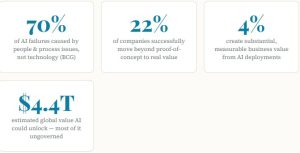
That 4% figure is not a technology problem. Those companies have access to the same models, the same APIs, the same talent pools as everyone else. What differentiates them is disciplined, structured, intentional governance.
Key Insight: Organizations that treat AI governance as an afterthought — something to figure out after deployment — consistently underperform those that embed governance structures before writing a single line of production AI code.
What Separates AI Governance from Traditional IT Management
If you’ve managed enterprise software for years, you may be tempted to apply the same oversight frameworks to AI. This is one of the most common and consequential mistakes organizations make in 2026.
Traditional software is deterministic. Microsoft Excel will perform the same calculation on a Tuesday in January as it does on a Friday in August. Your CRM system doesn’t spontaneously decide to categorize leads differently. There are no surprises just inputs and predictable outputs.
Artificial intelligence is fundamentally probabilistic. It learns. It adapts. Its outputs shift based on new data, changed context, and model updates. What produced reliable results last quarter might generate entirely different potentially problematic outputs this quarter.
| Dimension | Traditional Software | AI Systems |
|---|---|---|
| Output Behavior | Static and deterministic | Dynamic and probabilistic |
| Accountability | Clear, traceable | Diffuse, contested |
| Compliance | Straightforward audit trails | Complex explainability requirements |
| Error Pattern | Consistent, reproducible bugs | Emergent, context-dependent failures |
| Monitoring Need | Periodic checks | Continuous real-time oversight |
| Regulatory Risk | Well-understood frameworks | Rapidly evolving global regulations |
This behavioral difference is not merely technical. It fundamentally changes what good oversight looks like, who needs to be involved, and what controls must exist before deployment not after problems emerge.
Four Critical Governance Pillars Every Enterprise Needs Before 2027
Building effective AI governance is not about creating bureaucratic friction that slows innovation. It is about establishing intelligent guardrails that make speed sustainable and trust possible. Here are the four pillars that separate organizations with mature AI programs from those perpetually stuck in pilot hell.
Pillar 1: Data Sovereignty and Integrity Architecture
📌 Governance Insight
The most sophisticated AI algorithm becomes not just useless but dangerous when operating on compromised, incomplete, or improperly classified data. Data sovereignty governance establishes clear protocols: who owns each data asset, who may access it, how it may be used in AI training or inference, and what happens when something goes wrong.
Your marketing team wants to use AI for customer personalization? Governance ensures they cannot accidentally expose sensitive financial records to a public LLM endpoint.
Pillar 2: Human-in-the-Loop Checkpoint Design
📌 Human Oversight Insight
As agentic AI systems proliferate — systems that take independent actions, not just generate text — the stakes of inadequate oversight grow exponentially. Effective governance maps every AI-assisted workflow and explicitly defines which actions require human review before execution.
AI may draft customer communications autonomously; humans must approve before sending. AI may generate code; humans must review before deploying to production.
These are not bottlenecks — they are risk-controlled acceleration mechanisms that prevent catastrophic failures at scale.
Pillar 3: Shadow AI Detection and Containment
📌 Shadow AI Risk Insight
This is the governance challenge most organizations systematically underestimate. Right now, across your organization, employees are pasting confidential meeting transcripts into consumer chatbots, uploading customer data to free image generators, and using unapproved tools to automate sensitive workflows.
This “shadow AI” proliferation is arguably the single largest unaddressed enterprise security threat of 2026.
Governance approaches that rely solely on blocking and restriction consistently fail. Effective frameworks diagnose why employees are using unauthorized tools — almost always because authorized alternatives don’t meet their needs.
The most successful organizations create secure, sanctioned alternatives that deliver the capabilities employees need without exposing the business to unnecessary risk.
Pillar 4: Accountability and Escalation Mapping
📌 Accountability & Incident Response Insight
When an AI system makes a consequential error — and they will — your organization must have pre-defined answers to every accountability question.
Who is responsible? What is the escalation path? How is the affected party notified? What remediation steps are required?
Organizations without accountability maps discover these answers under crisis conditions, at the worst possible moment.
Mature governance organizations have documented, rehearsed, and regularly updated their incident response protocols long before they need them.
The EU AI Act Is Now Enforceable What Every Global Organization Must Do Immediately
For years, AI regulation existed in the realm of “eventually.” Executives discussed potential compliance obligations in future-tense language. That era ended in 2026. The EU AI Act is now fully enforceable, and it carries penalties that rival the most aggressive GDPR enforcement actions in history.
This is not a suggestion framework. It is binding law with real financial consequences for organizations that fail to comply.
High-Risk AI Applications: What the Law Now Requires
The Act categorizes AI applications by risk level. Systems used in education, employment screening, access to essential services, law enforcement, and credit assessment are classified as high-risk. If your organization operates in, or sells to, the European Union and uses AI in any of these domains, the following are no longer optional:
Complete, maintained inventories of every AI system deployed across the organization
Documented risk assessments for each AI application, updated at meaningful intervals
Functioning human oversight mechanisms capable of intervening in real-time
Transparency documentation explaining, in auditable terms, how AI systems make decisions
Data governance records demonstrating compliant training and inference data practices
Post-market monitoring systems that detect and report significant incidents
⚠️ Critical Warning
Organizations cannot govern AI systems they do not know they have. The inventory requirement is foundational — it is also where most organizations discover they have dramatically more AI exposure than their leadership realizes. Shadow AI makes this inventory exercise far more complex than it initially appears.
The Compliance Reality Gap: Where Theory Meets Execution
| What Regulators Require | What Most Organizations Have | The Resulting Problem |
|---|---|---|
| Explainable model decisions | Black-box deep learning models | Cannot articulate why the system decided X |
| Clean, auditable data governance | Fragmented, siloed legacy databases | Data cleaning consumes 70–80% of compliance budget |
| Genuine human oversight | Automation-biased teams that rubber-stamp AI outputs | Oversight exists on paper but not in practice |
| Real-time incident reporting | No monitoring infrastructure | Problems discovered weeks after they occur |
The Global Governance Fragmentation Problem and Why It Demands Adaptable Frameworks
While the European Union has established the most comprehensive legal framework, the global regulatory landscape in 2026 resembles a patchwork quilt. For organizations operating across multiple jurisdictions, this fragmentation creates significant strategic complexity.
The Emerging “Splinternet” of AI Regulation
| Region | Regulatory Approach | Key Requirement | 2026 Status |
|---|---|---|---|
| European Union | Comprehensive, risk-tiered | Full compliance with AI Act | Fully enforceable |
| United States | Sector-specific, fragmented | Varies by industry vertical | Evolving rapidly |
| China | Government-centric oversight | Content controls, state review | Actively enforced |
| United Kingdom | Principles-based, adaptive | Sector regulator coordination | Embedding expertise internally |
| Gulf Region | Investment-led, developing | Framework under construction | Billions invested, rules emerging |
The United Kingdom’s “Govern From Within” Model
One of the more instructive regulatory experiments currently underway is the UK’s approach of embedding senior AI specialists directly inside public service organizations transport, healthcare, national security rather than relying entirely on external oversight. This “govern from within” model creates genuine technical expertise at the point of decision-making. Early evidence suggests it produces more nuanced, practical, and adaptable oversight than pure external regulation can achieve. Organizations building internal AI governance functions would do well to study this model closely.
The Operational Realities Nobody Discusses at AI Conferences
The gap between governance theory and governance practice is wide and often brutal. Understanding exactly why implementation is so difficult is prerequisite to overcoming these challenges rather than being quietly defeated by them.
Legacy Systems Create Architectural Incompatibility
The majority of large enterprises operate on core infrastructure built fifteen to twenty-five years ago. Attempting to overlay modern AI governance frameworks onto legacy databases and monolithic systems is analogous to installing flight navigation software on a 1970s mainframe. The underlying architecture simply was not designed to provide the audit trails, data lineage documentation, real-time monitoring feeds, or explainability logs that modern AI governance demands.
This is not an insurmountable problem but it is an expensive and time-consuming one that must be confronted honestly in governance planning, not optimistically underestimated.
What’s Changing Right Now: Real Governance Developments Reshaping the Landscape
The AI governance landscape moves faster than annual strategy cycles can accommodate. Here are the most significant developments organizations need to track actively in 2026.
ISO/IEC 42001: The Emerging Global Gold Standard
ISO/IEC 42001 — the international standard for AI Management Systems — is rapidly becoming the certification that enterprise partners, investors, regulators, and customers are beginning to require. What distinguishes it from compliance checklists is its emphasis on ethics-by-design: building responsible practices into development processes from the first line of code rather than conducting ethics reviews after systems are already in production.
Achieving certification requires genuine cross-functional governance committees that integrate perspectives from technology, legal, human resources, risk management, and business leadership. Organizations beginning this process now position themselves ahead of what is increasingly likely to become a baseline market expectation within three years.
Agentic AI Introduces Exponentially Higher Governance Stakes
The transition from AI-as-assistant to AI-as-agent systems that independently schedule meetings, execute transactions, send communications, and make operational decisions represents a qualitative leap in governance complexity, not merely a quantitative one. An AI agent that takes a wrong action does not just generate incorrect text. It may send the wrong contract, commit organizational resources, or trigger irreversible downstream processes. Working with a custom AI agent development company can help organizations design these systems with appropriate controls, permissions, and safeguards from the outset.
Organizations deploying agentic systems without purpose-built governance frameworks are running one of the highest-stakes experiments in modern business history.
From “Can We Build This?” to “Should We, and How Do We Control It?”
The first era of enterprise AI was defined by the capability question: Can we build this? Thanks to the proliferation of open-source models, accessible APIs, and commoditized infrastructure, the answer to that question is now almost universally yes.
The second era the one your organization is navigating today is defined by the governance question: Should we build this, and how do we ensure it operates within boundaries we have deliberately chosen?
Making AI Governance Your Organization’s Defining Competitive Advantage
The organizations that dominate the next decade of business will not simply be those with the most capable AI models. They will be the ones whose governance structures create stakeholder trust, regulatory confidence, and operational predictability that competitors cannot match.
This requires a fundamental perspective shift. Stop treating AI as a technology project to be managed by IT and evaluated on technical performance metrics alone. Start treating it as what it actually is: a governance challenge requiring human wisdom, organizational discipline, ethical frameworks, and sustained executive commitment.
The race in enterprise AI has never been about who deploys fastest. It has always been about who controls most effectively, builds trust most durably, and creates value most sustainably. Your competitors are beginning to understand this. The organizations that grasp it now and build the governance infrastructure to act on it will establish advantages that are extraordinarily difficult to replicate later.
Frequently Asked Questions About AI Governance
What exactly is AI governance and why does it matter?
AI governance refers to the policies, processes, accountability structures, and oversight mechanisms an organization uses to manage how artificial intelligence systems are developed, deployed, and monitored. It matters because without it, AI systems operate without defined accountability, create unmanaged legal and security exposure, and consistently fail to deliver sustainable business value.
How is the EU AI Act affecting businesses outside Europe?
Any organization that operates in the European Union, sells products or services to EU-based customers, or processes data involving EU residents must comply with the EU AI Act regardless of where the organization is headquartered. This gives it global reach comparable to GDPR’s extraterritorial effect.
What is “shadow AI” and how serious a risk does it present?
Shadow AI refers to AI tools and applications that employees adopt and use without organizational approval or IT oversight. In 2026, this represents one of the most significant unmanaged security and compliance risks in enterprise environments, as employees routinely share sensitive organizational data with consumer AI services that have no contractual data protection obligations to the employer.
What is ISO/IEC 42001 and should our organization pursue certification?
ISO/IEC 42001 is the international standard for AI Management Systems, providing a structured framework for organizations to manage AI responsibly throughout its lifecycle. Certification is increasingly expected by enterprise customers, institutional investors, and regulators. Organizations in industries with heightened AI risk exposure—financial services, healthcare, employment, and law enforcement—should treat certification as a near-term strategic priority rather than a long-term aspiration.
Read More info Visit: https://searchenginegeneral.com/



